
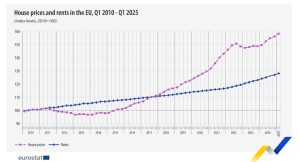
The European real estate market is experiencing its strongest surge in nearly ten years. According to Eurostat, from 2010 to Q1 2025, housing prices in the European Union (EU) have risen by a total of 57.9%, while rental prices increased by 27.8%. Rental growth has been steady year after year, but housing prices have seen sharp spikes, particularly between 2015 and 2022, and continue to climb from 2024.
In the first quarter of 2025, the European property market showed clear signs of recovery. Average housing prices rose by 5.7% year-on-year and 1.4% compared to the previous quarter. Rental prices also increased by 3.2% year-on-year and 0.9% quarter-on-quarter, reflecting a return of growth momentum after a period of stagnation. The main drivers include rising construction costs, high mortgage interest rates, limited housing supply, and strong investment demand from both local residents and international investors.
Hungary recorded the highest housing price increase in the EU, ranging from EUR 250,000 to EUR 1.5 million. In Iceland, home prices in the capital Reykjavik surged 2.5 times year-on-year, with the average reaching EUR 558,000. Other countries such as Lithuania, Portugal, Czechia, Bulgaria, Estonia, and Poland have all seen prices more than double since 2015. In Greece, although no official average is available, the urban housing market has surpassed its previous peak set in 2008.
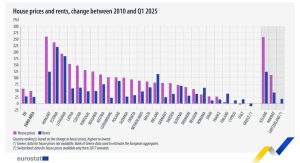
Notably, 21 out of 26 European countries reported house price growth outpacing rent increases. Hungary leads with 260%, Estonia 238%, Lithuania 194%, Latvia 154%, Czechia 147%, Portugal 130%, Bulgaria 125%, Austria 113%, while Luxembourg and Poland both rose 102%, and Slovakia reached 100%. Italy is the only country where housing prices fell, down 4% compared to 2010.
Meanwhile, rental prices also rose across all 26 EU countries, with notable increases in Estonia (+220%), Lithuania (+184%), Hungary (+124%), and Ireland (+115%). In contrast, Greece was the only country to record a decline, with rental prices down 11%.
The sharp rise in both housing and rental prices reflects not only supply-demand imbalances but also important economic dynamics. On the one hand, it highlights growing real housing demand and rental demand, especially in major economic hubs, tourist cities, and countries with open policies toward foreign investors. This is a positive sign for investors, as European real estate offers both value appreciation and stable rental income.
On the other hand, rapid price escalation raises concerns about sustainability. Housing shortages, rising living costs, and prolonged inflation could push prices beyond real value, creating the risk of a property bubble in certain markets. Therefore, in such a volatile environment, choosing the right country and conducting thorough market analysis will be crucial for safe and profitable investment in 2025.
The year 2025 presents a European real estate landscape that is both promising and challenging. Rising housing and rental prices reflect strong demand and continuous capital inflows into the market. However, not all countries guarantee the same level of profitability and safety.
Investors need clear strategies, in-depth analysis, and must avoid blindly following market trends. With the right approach, investing in European real estate in 2025 will not only be a financial decision but also a strategic step for the long-term future of the entire family.
Ready to invest in European real estate? Contact us today for a tailored consultation.